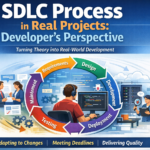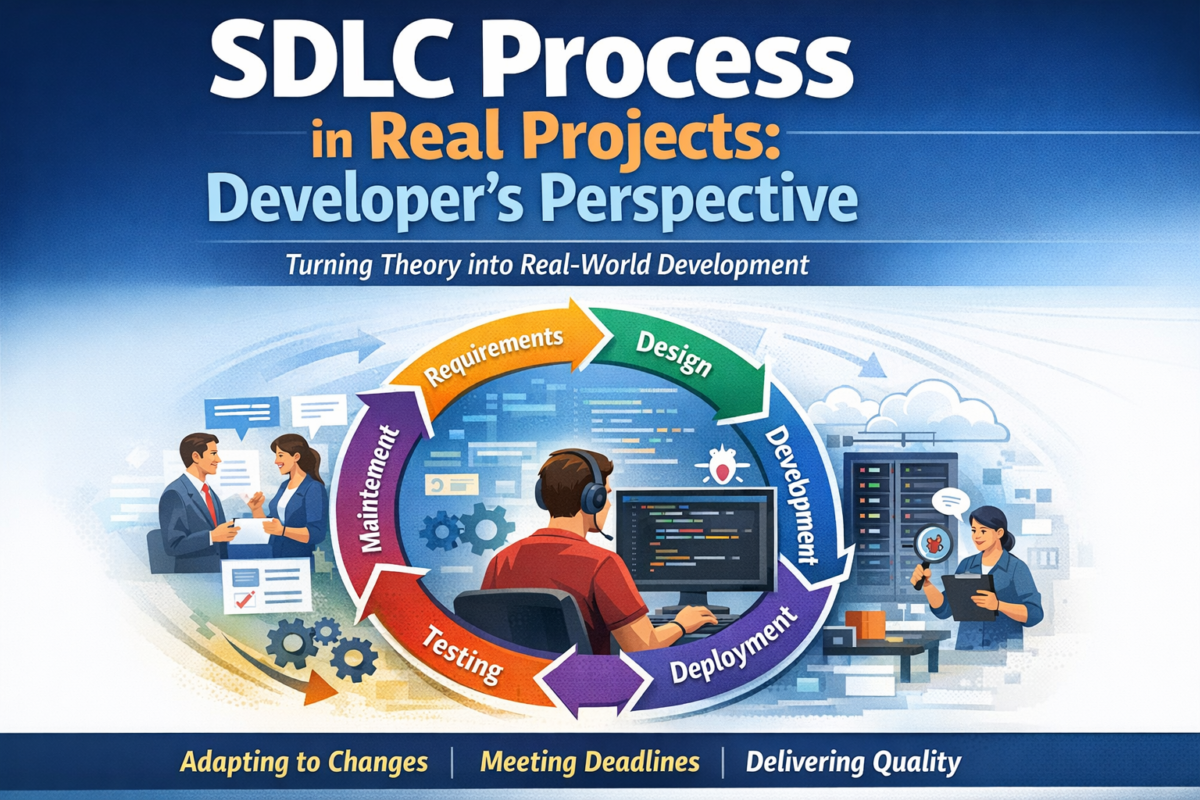
SDLC Process in Real Projects: Developer’s Perspective
In theory, the Software Development Life Cycle (SDLC) looks simple—define requirements, design, develop, test, deploy, and maintain. But in real-world software projects, SDLC is far more dynamic, collaborative, and sometimes unpredictable. From a developer’s perspective, SDLC is not just a framework; it’s a practical roadmap that helps teams deliver quality software while handling changing requirements, tight deadlines, and real client expectations.
This article explains how the SDLC process actually works in real projects, based on hands-on development experience, and why following SDLC properly is critical for successful software delivery.
What Is SDLC in Real-World Software Development?
SDLC is a structured approach used to plan, build, test, deploy, and maintain software systems. While textbooks describe SDLC as a linear or cyclic model, real projects rarely follow a perfectly straight line.
Clients change requirements, priorities shift, and technical challenges emerge. A good SDLC implementation allows developers to adapt without losing control over quality, timelines, and cost.
Phase 1: Requirement Gathering – Where Reality Begins
In real projects, requirements are never 100% clear on day one. From a developer’s perspective, this phase involves:
- Understanding business goals, not just features
- Translating client language into technical requirements
- Identifying missing or conflicting expectations
A common challenge is that clients often discover what they really want after seeing the first version. That’s why developers document requirements clearly and confirm them through meetings, wireframes, or prototypes.
👉 Strong requirement analysis reduces rework and saves development cost.
Phase 2: System Design – Balancing Ideal vs Practical
Designing software in real projects is about trade-offs:
- Performance vs budget
- Scalability vs delivery time
- Customization vs maintainability
Developers create architecture diagrams, database designs, and API flows while keeping future growth in mind. Unlike theory, designs are often revisited multiple times as new requirements emerge.
Phase 3: Development – Where the Real Work Happens
This is the most visible phase, but also the most misunderstood. In real SDLC implementation:
- Development happens in iterations or sprints
- Code reviews, version control, and documentation are critical
- Developers continuously align with testers and project managers
From experience, projects succeed when developers focus not only on writing code, but also on clean, readable, and scalable solutions.
Phase 4: Testing – More Than Just Finding Bugs
In real projects, testing is not a final step—it runs parallel to development. Developers work closely with QA teams to:
- Fix bugs early
- Validate business logic
- Ensure performance and security
Many issues arise from edge cases that were never discussed in requirements. Early and continuous testing ensures the software behaves correctly in real user scenarios.
Phase 5: Deployment – The Most Sensitive Stage
Deployment might be stressful in real-world SDLC. Even a tiny configuration problem can result in downtime. Developers must deal with
- Environment setup (server, cloud, CI/CD)
- Data migration
- Production-level security
Successful deployment requires proper planning, backups, and rollback strategies—things often ignored in theoretical SDLC explanations.
Phase 6: Maintenance & Support – The Long-Term Reality
Most of the life of a software product is spent in maintenance. This phase includes the following:
- Bug fixes and performance improvements
- Feature Enhancements
- Adapting to new business rules and technologies
This is where clean architecture and good documentation prove their value. Poor SDLC practices in early phases result in very expensive maintenance later.
SDLC Models in Real Projects
While there are several SDLC models, most real projects actually use a combination or hybrid approach:
- Agile for flexibility
- Waterfall for government or compliance-heavy projects
- DevOps for faster delivery and automation
- The key lesson is that no single SDLC model suits all projects.
- Why SDLC matters in real projects
- From the developer’s perspective, SDLC:
- Reduces project risk
- Improves communication with clients.
- Ensures Predictable Delivery
- Helps teams manage change effectively.
Projects that skip SDLC steps experience delays, budget overruns, and quality issues.
Final Thoughts
SDLC in real projects is all about disciplined flexibility rather than rigid rules. Only developers who understand SDLC beyond theory can build reliable, scalable software, with a close linkage to business objectives.
By applying SDLC with real-world awareness, software teams can turn complex requirements into successful digital solutions-on time and with confidence.